Sunday, May 31, 2009

Some painting energy released

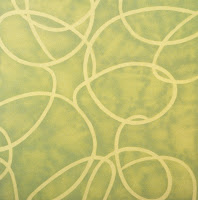
I had a burst of energy the other day and so flung some paint onto a blank canvas and ended up with this. At first I hated it -- too Jackson Pollock-y -- and was going to cut it up, but I couldn't stop staring at it. There's something happening there that I actually like! Not sure what yet, or where it will lead.


I had an idea of making a bunch of square paintings like this, in tons of different bright colors, but then I added up the cost of new paints and put the brakes on. I'm also still chugging away with the Yellow Web series (soon to appear on my updated website) and in fact have just created a brand new one (will post a picture when it's dry). So, a bunch of possible different directions (as usual)!

Friday, May 29, 2009

Taking care of business

Today I received an order of greeting cards with an image of my artwork on the front. Now I can send thank-you or inquiry notes with a professional touch (my website address appears on the back).


Also today I mailed off a CD with images of new work to the talented web designer Jeanne Williamson, who will soon be updating my website.

Saturday, May 23, 2009

Art students beware!

Had lunch on Thursday with another art teacher from the museum school I teach at, and the subject of "non-teaching teachers" came up again. I have discussed this subject in an earlier blog post, but it never fails to amaze me. Apparently it's an experience many have had.

My colleague told me that during a class recently, she was explaining the different types of brushes available (rounds, flats, filberts). And one of her students, who has a B.F.A. from a prestigious art program, came up to her and thanked her for relaying this information, that she had never heard it before!

Now I have to admit, one doesn't really need to know the various types of brushes to be a good painter. Frankly, I just grab whatever is there. If it's a round, fine, if it's a paper towel, fine.

But when you have shelled out upwards of $100,000 for an art education, you like to think that someone would have clued you in to this basic information at some point over the four-year period.

Again I ask myself, having had similar experiences as a student, HOW do people who are earning tenured professors' salaries manage to get away with not doing their jobs? If their conscience doesn't get them, which apparently it doesn't, why doesn't the system catch them?

If you were a baker and a customer came into your bakery and asked for a cake, and you wouldn't give them one, they would leave and not come back, and you'd be out of a job. If you were a cab driver and someone got into your cab and you refused to drive them anywhere, they would leave and not come back, and you'd be out of a job. So how is it that (some) art professors can get away with not teaching their students?

I guess it riles me so much because I had teachers like that, and at the time I made excuses for them, continued to pay my tuition, and learned by reading books on art technique plus trial and error in my own studio. Now as a teacher myself, I feel it is my job to educate as thoroughly as I can -- not to read the newspaper, attend conferences, stay home and work on writing a book on how to draw, or any of the other things my professors did instead of teach class.

I guess it makes you appreciate your dedicated teachers more, and figure that there must be some justice out there somewhere for people who don't do what they are hired to do.

Wednesday, May 20, 2009

New stuff

Here's some new stuff ... first, an older painting (January) I decided I didn't like in larger form, so I cut it down and turned it "sideways" (now it's 30" H x 20" W):


Then, some new blue works on paper, 30" H x 20" W:


Excuse the yucky picture quality, but if you click on the images, you can get a better idea of the textures, which obviously are much richer than how they appear here.

Monday, May 18, 2009

Fake it 'til you make it


Phew, it's been a busy spring for exhibitions! Between January and two weeks ago, I was in a three-person show at a college, plus three 10- (or so) person group shows.

That's an accomplishment professionally. However, being the Type A person that I am (career-wise, anyway), I can't help looking forward and thinking, "What's next?"

I have a two-person show coming up next spring, but that doesn't have definite dates scheduled yet, so it still seems a bit unreal.

So, since I have become used to painting with an upcoming show in mind, as a kind of inspiration, I've decided to pretend I have a solo show at a large exhibition space coming up, and paint with that in mind. That way, I will feel that excited anticipation that comes from knowing a large number of people will be seeing your work and connecting to it, and enjoy that challenge of needing to say something honest and worthwhile.

And who knows, maybe it will be like "I Whistle A Happy Tune" in "The King and I"; if you make believe you're brave, you may be as brave as you make believe you are! Translation: if I make believe I have a solo show, I will have a solo show! (And if not, I'll have a body of work ready for when I eventually do.)

Sunday, May 17, 2009

A completely different reaction


In an earlier post, I wrote about my friend who had received the bitchy email response to the group sculpture show she was in.

This recent newspaper article about her show includes the following anecdote, which serves as a natural rebuttal to the negative emailer:

" ... the majority of park-goers have been delighted by the surreal quality the installations lend to the park. One group of day-care children was so enthralled by the sculptures, they sat down and started building impromptu sculptures from chunks of asphalt and other debris along the path.

"We came by on accident on Friday, and we just had to come back today," said Sarah Lemos, an employee at the Clinton Path Preschool in Brookline Village. “They’re completely inspired."


If adults could carry a childlike wonder and appreciation with them each day, the world would be a better place! Either that, or keep their negative opinions to themselves. It's easier to criticize someone else's creative efforts than to focus on your own.

Go Wendy! Go Clinton Path preschoolers!

Saturday, May 16, 2009

Masterful drawing

As my students were quietly working away the other day, I sat down and whipped out a drawing myself. I had been meaning to experiment with oil pastels, which we have in abundance at the Danforth Museum School for kids classes to use. I had no preconceived notions of how to use these pastels because I've never really used them before. So I just played around with marks and layers to see what happened.

One of the students observed my drawing and said, "That's what we want to learn to do -- to be able to just sit down and dash off a terrific-looking drawing like that!"

I was very flattered by what he said, but it occurred to me when I got home (when all perfect answers come to me, long after the situation is over and once I am back home!) that there were three specific things that made my drawing successful, and all of them are completely within my beginning students' grasp.

First is PRACTICE. I have been drawing for a long, long time. My students have more likely been drawing for less time. But learning to draw well (like learning to do anything else well) takes years and years and years of practice, practice, practice.

Second is CONFIDENCE. I have a lot of confidence when I draw. I like to go for the gusto -- bold, broad marks that "take no prisoners," really explore and examine what I am drawing. And the reason I have confidence is because ...

Three, MISTAKES ARE OK. I make it a point to do what I think most students don't do. That is, if I think a drawing sucks, I can either keep working on it, save it to remember what I don't want to do again next time, or throw it out. This is no reflection on my ability. Maybe I am using the wrong materials, maybe the planets are out of alignment, whatever. There can be a million reasons why a drawing doesn't seem to be working. But none of this means you are no good or that you should stop drawing.

Students tend to think of each individual drawing as a weight on their shoulders. They HAVE to finish it, it HAS to look exactly like what they first envisioned, and it HAS to impress everyone who sees it with how beautiful it is and how brilliant its creator is.

NO. A drawing is an end product of a moment of exploration, expression and fun. If it's great-looking and ends up on a wall behind a frame, great. If not, still great. You enjoyed yourself and learned something.

Why put such pressure on yourself, to make a "perfect" drawing? There are plenty of unpleasant pressures in life that we can't avoid. (Death and taxes are the first two that come to mind.) Why bring unnecessary pressure into the studio (or the art classroom)? The studio should be a place to experiment, play, learn and grow, not a place of judgment, criticism or anguish.

If students would be willing to put in the time, feel confident or at least pretend that they do, and not expect every drawing to be a masterpiece, they would be much better artists.

Thursday, May 14, 2009

Self-reflection


I keep a photo diary. For every year of my life, I have a page with a photo of myself from that year, and a page beside it listing what I did that year. For my childhood years, obviously, it's just a list of what grade I was in or where my family was living that year. As an adult, it's what degree I earned or what job I held.

Last year I was SO BUSY that I didn't have time to make a 2008 entry at all. In fact, I forgot I was even keeping the diary until I found it among my photo albums when I was looking for a Mother's Day picture the other day.

So I decided to bring it up to date yesterday. In looking back over my 2008 calendar and making my list of activities for the year, I realized (with shame) that I have gained 15 pounds since this time last year, and I had the flu from early January to late February 2009.

I told my husband about all the things in my life I feel I've been neglecting (which obviously includes my health), and he said that instead I need to focus on what I have accomplished.

So I decided to take his advice and make a list of all the things I've done since January 2008, up to now. This included the following:

I showed my paintings in 9 exhibits. (For one of them, my painting was used for the invitation, and the Boston Globe review of that show mentioned my work specifically.)

I sold 11 paintings.

I had 6 artist profiles published (plus a number of reviews).

I developed from scratch and successfully taught (at least once) 3 graduate-level courses and 2 workshops, plus I gave private lessons.

I also developed from scratch and successfully taught (at least once) the following courses: fashion illustration, acrylic additives, landscape drawing/painting, and botanical illustration.

This experience serves as a reminder that when we focus on one area of our lives, there's only so much time in a day and so many days in a year, so other aspects of life might be neglected or overlooked. It's important to take the time on a regular basis to re-evaluate and possibly rework our plans and goals.

I have focused on career to a great extent since 2008. Time now to turn my attention to exercise and healthy foods, and concentrate on that until my body brings itself back into balance.

Sunday, May 10, 2009

"Should" has no place in art!


Yesterday my graduate-level landscape drawing class went out to another lovely park to work, and I was reminded of an important consideration in the artistic process. Arguably, THE ONLY CONSIDERATION YOU NEED in order to make "honest" art.

The park we went to was a challenging subject. It had many, many old trees with intriguing trunks and branches, as well as many lovely flowering trees. Add to that, it was a gorgeous spring day, partly cloudy so the sun wasn't too direct and there were no sharp shadows to chase, warm but not too hot, breezy but not too windy. In short, many lovely views to pick from, along with the stimulus of an invigorating environment.

Four students had a satisfying experience. They walked around, did some thumbnail sketches, then picked a view or tree to draw, threw themselves into the process of creation, and emerged with a picture that pleased them.

Two other students hesitated as to how to get started. They had started with an idea of what they "should" do that day, and when actually confronted with the view, they changed their minds when they found something else that called to them. I was able to talk them through this inner conflict, help them figure out what they WANTED to do based on the scene in front of them, and encourage them to let go of the original plan and go with what excited them.

And one student was, at first sight, fascinated by a row of metal boxes affixed to a series of telephone poles along the edge of the park (which I guess contained electrical outlets, telephone lines or something of that nature). But he thought he was "supposed" to be doing a landscape of trees, bushes, etc., so he started a picture of a traditional view.

By the time I got around to help him, he was totally frustrated with this start. He mentioned the metal boxes and I realized, THIS is what excites him, not the trees and flowers. So I encouraged him to draw the boxes instead.

When I got back around to him after talking with the other students, he had created an intricate detailed picture of the boxes, but was hemming and hawing about how to include the trees and shrubs growing nearby, which he thought he "should" include. He had started to sketch in a tree trunk, and it took away from the sharp edges and dramatic perspective that made his initial drawing so amazing.

I encouraged him to concentrate on the "man-made" aspects of his subject matter, and not feel obligated to include something that didn't interest him, just because it was there. (I also offered to do a tree-drawing demonstration next week, in case it was simply inexperience that was causing him to hesitate. Although I don't think so, based on the drawing skill he's shown in my class.)

So he ended up with a wonderful and unique drawing that wasn't a traditional landscape but instead his own interpretation of what landscape means. (That is, no grass or trees, but the suggestion of where they are, based on how the boxes, wires and fences are situated and shaped.)

There is a lesson here for artists in general. Definitely, there are some days when everything you draw looks great, and other days when nothing you draw looks even half-decent. (Luckily, most days fall somewhere in between.)

But -- the fickleness of the art muse aside -- you must draw ONLY WHAT EXCITES YOU. If you throw in things you think you "should" draw, or if you follow some pre-conceived notion of what your drawing "should" be, you will miss out on honestly expressing yourself. If something isn't working, you have to try something else. Let it go and move on.

I've found I can even FEEL when I'm off the path I need to be on, while in the middle of making a work of art. If I add a color that isn't working, or include an element that throws the picture off kilter, I can literally feel my heart sink a little. Whereas if a composition is right, or a new texture comes about that really contributes to the piece, my heart feels a little spark and gives a little jump of joy. That tells me I've done the right thing.

In short, my advice is: FOLLOW YOUR HEART!

Tuesday, May 5, 2009

Wonderful news


It turns out that I have sold two paintings, possibly four, to a company that is moving to new office suites in the John Hancock building. Very exciting! Above is one of the works that sold.

Every time I see the John Hancock, I will think of my paintings hanging in there!

Monday, May 4, 2009

Valuable feedback

If you ever need a reminder of why it's important to tell others when you like what they do, especially creative people, here's a story for you.

A friend of mine is currently participating in a month-long group sculpture exhibit, which consists of approximately 10 installations created on site in a public park, inspired by the natural setting.

Today, she and the other artists in the group received this email message from an observer of the show:

"I am generally a lover of the arts, but I want to give feedback on the ... installation to you and your fellow artists. The reason I walk [through this area] is to see nature, not man-made additions. I really do not like the whole exhibition and can’t wait for it to be removed. Sorry to be so negative, but I was really bothered by the installations when I walked to work today."

This, to me, is a life lesson. Critical people apparently don't hesitate to speak up and make others feel bad. It's important to speak up when you have something GOOD to say, so you can make others feel great.

Sunday, May 3, 2009

Quartet


Made another tiny painting last night. Here are four from the bunch that go well together. For some odd reason, they make me think of those funky line drawings, often on a bright solid background, that used to appear on the cover of jazz albums in the 1950s ...

Now I have to organize this series and get them out into the world!

Friday, May 1, 2009

Drawing from Nature


Among the four classes I'm currently teaching at the Danforth Museum School in Framingham, MA, is a landscape drawing course. Yesterday was PERFECT weather for our weekly adventure, and my 8 students and I headed over to Farm Pond in Framingham to capture some of the springtime view.

Sometimes I get a chance to squeeze in a bit of my own interpretation while the students are working; above is one I made in watercolor. Since I never work from observation in my own artwork, it's interesting to me to see what happens when I do!