
Showing posts with label Printmaking. Show all posts
Showing posts with label Printmaking. Show all posts
Monday, November 3, 2014
A touch of red
To switch gears a bit from my recent drawings, tonight I'm patterning some lengths of fabric in anticipation of creating a new collage painting. I enjoy switching modes like this. Some times I feel like working in a detailed manner, as in the precise "bubble" drawings I've been making for the past few months; other times my arm just wants to SWOOP!

Saturday, January 25, 2014
Looking good on paper
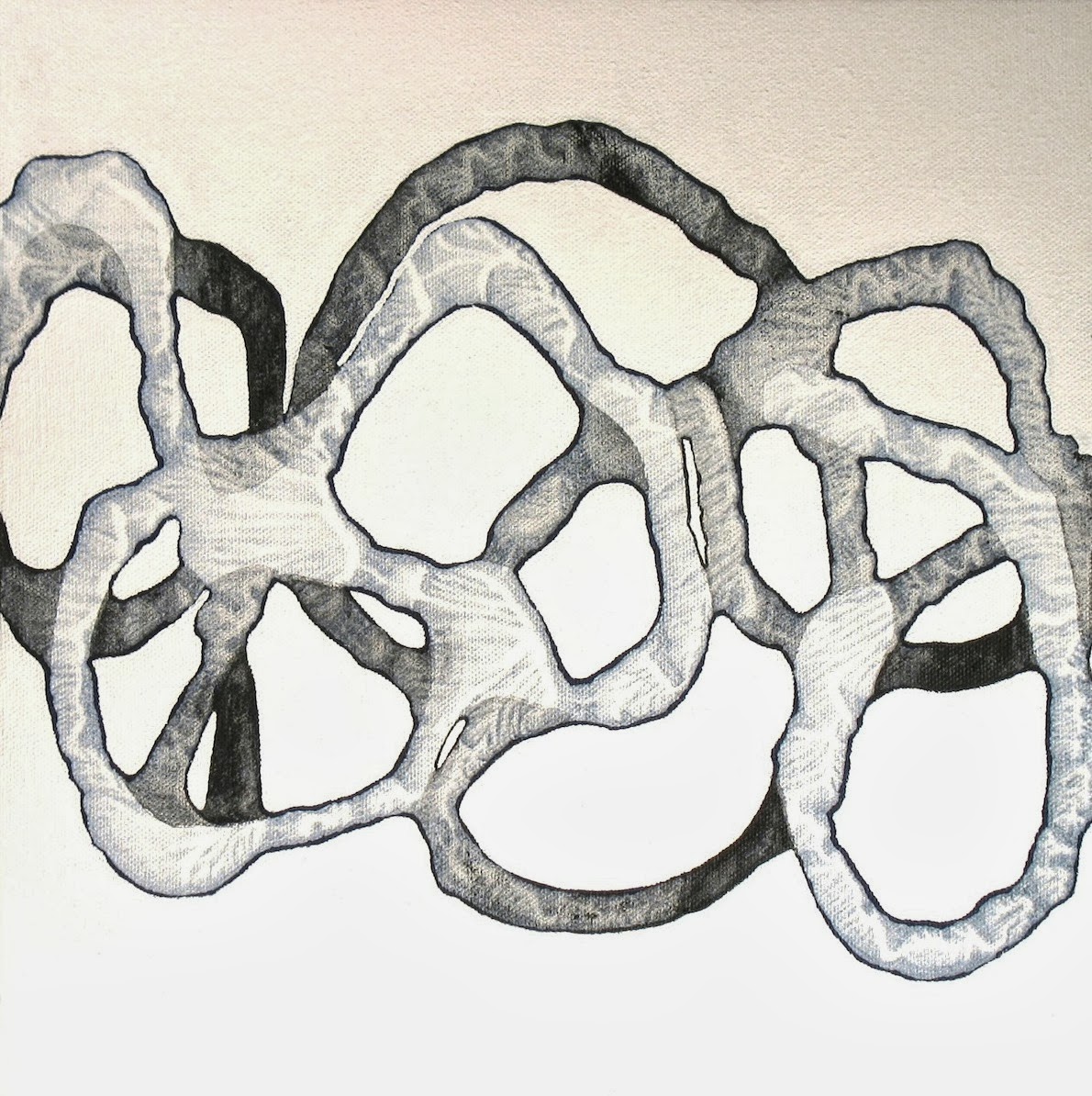
I decided to return to working on paper again for a change, after having painted exclusively on stretched canvas for a while. So I purchased a new pack of 30" x 22" paper, loaded up my squeeze bottles with fluid acrylics, and I was ready to go!
In this process, I draw lines with the squeeze bottle onto the paper, lay another piece of paper on top, and roll over it with a brayer, essentially making a monotype. The beauty of this process is that I am left with two replica images; one can be left as is, and the other can be reworked for as long as desired. This eliminates the disheartening "oh no, why did I paint over that - now I've wrecked it!" experience. (We painters are always lamenting that we don't have a "Control-Z" feature when we work ... )
I'm having such FUN!


In this process, I draw lines with the squeeze bottle onto the paper, lay another piece of paper on top, and roll over it with a brayer, essentially making a monotype. The beauty of this process is that I am left with two replica images; one can be left as is, and the other can be reworked for as long as desired. This eliminates the disheartening "oh no, why did I paint over that - now I've wrecked it!" experience. (We painters are always lamenting that we don't have a "Control-Z" feature when we work ... )
I'm having such FUN!
Thursday, September 26, 2013
Emulating Ernst: An Art History Lesson
 |
| Ernst's decalomania |
One of my colleagues, an art history professor, kindly attended the closing reception last night of the three-person show I've just participated in at Framingham State University, titled "Actions \ Reactions." During her visit, she noted the textured surface of the script-like lines in my paintings and told me they reminded her of a process utilized by the Surrealists, Max Ernst in particular, titled "Decalomania."
I'm so grateful to her for this observation because, while I was generally familiar with the series in which Ernst used this technique, I didn't know much about it and certainly had never made the connection between that method of working and what I do in the studio.
Decalomania basically means making a print from a coating of still-wet paint. When the two surfaces are pulled apart, their squishy separation causes a series of intricate ripples that look as though they are the result of painstakingly applied brushwork. And of course they are anything but painstaking! Those little rivulets aren't controlled by the artist at all; like so many interesting surfaces in art, they "just happen."
When I make my line paintings, I "draw" the lines by extruding diluted acrylic paint through ketchup bottles. The lines that flow out of the squeeze bottles are rounded and precise, and often I want them to look flat and wavery. So I lay a sheet of paper on the wet surface, flatten it with a brayer, and peel it off, leaving tiny facets inside each line. That's my personalized version of decalomania!
 | |
| Detail of "Shorthand" by Catherine Carter, acrylic on canvas, 2013, approximately 40" square |
I found THIS extensive blog post about the process, and its use by Ernst. This writer suggests that decalomania might have saved Ernst's life! Apparently when he was fleeing Vichy France in 1940, he was stopped just as he was about to board a train bound for Spain. A suspicious official rifled through the belongings he was carrying, which included rolled canvases that happened to include the decalomania technique. The man saw the elaborate "ribbed" sections of Ernst's works and thought he must have painted those areas with a tiny brush. He pronounced, "You, sir, have great talent" and escorted Ernst to the train. (If he hadn't been so transfixed by the technique, he might have been more aware of the works' "untraditional" content and taken the artist into custody!)
HERE is another interesting link about Ernst's masterpiece, "Europe After the Rain II," an oil painting chock full of decalomania.
 |
| "Europe After the Rain II" by Max Ernst, oil on canvas, 1940-42, approximately 2 feet high by 5 feet wide. |
Wednesday, June 30, 2010
Deep Sea series
Had professional photos taken of three of my favorite pieces from the monotype series I made earlier this month. I've decided to exhibit them as a group, in separate frames:
Below: "Deep Sea 1," "2" and "3." Each: Acrylic on paper, 29" H x 20.75" W


Below: "Deep Sea 1," "2" and "3." Each: Acrylic on paper, 29" H x 20.75" W


Monday, June 14, 2010
New monotypes
Made a series of 6 new monotypes over the weekend, using the Degas method of pressing a piece of paper against the wet surface of a "failed" painting.


Here is a detail:

Not sure how I'll display these, as they are all different sizes and they look good individually, as a separately framed group, or in a conjoined row. I also have some fabric that's a similar color, and I might paint on the fabric and then collage it into strips alongside the monotypes, as in these older pieces:

We'll see ... so many possibilities!


Here is a detail:

Not sure how I'll display these, as they are all different sizes and they look good individually, as a separately framed group, or in a conjoined row. I also have some fabric that's a similar color, and I might paint on the fabric and then collage it into strips alongside the monotypes, as in these older pieces:

We'll see ... so many possibilities!
Subscribe to:
Posts (Atom)