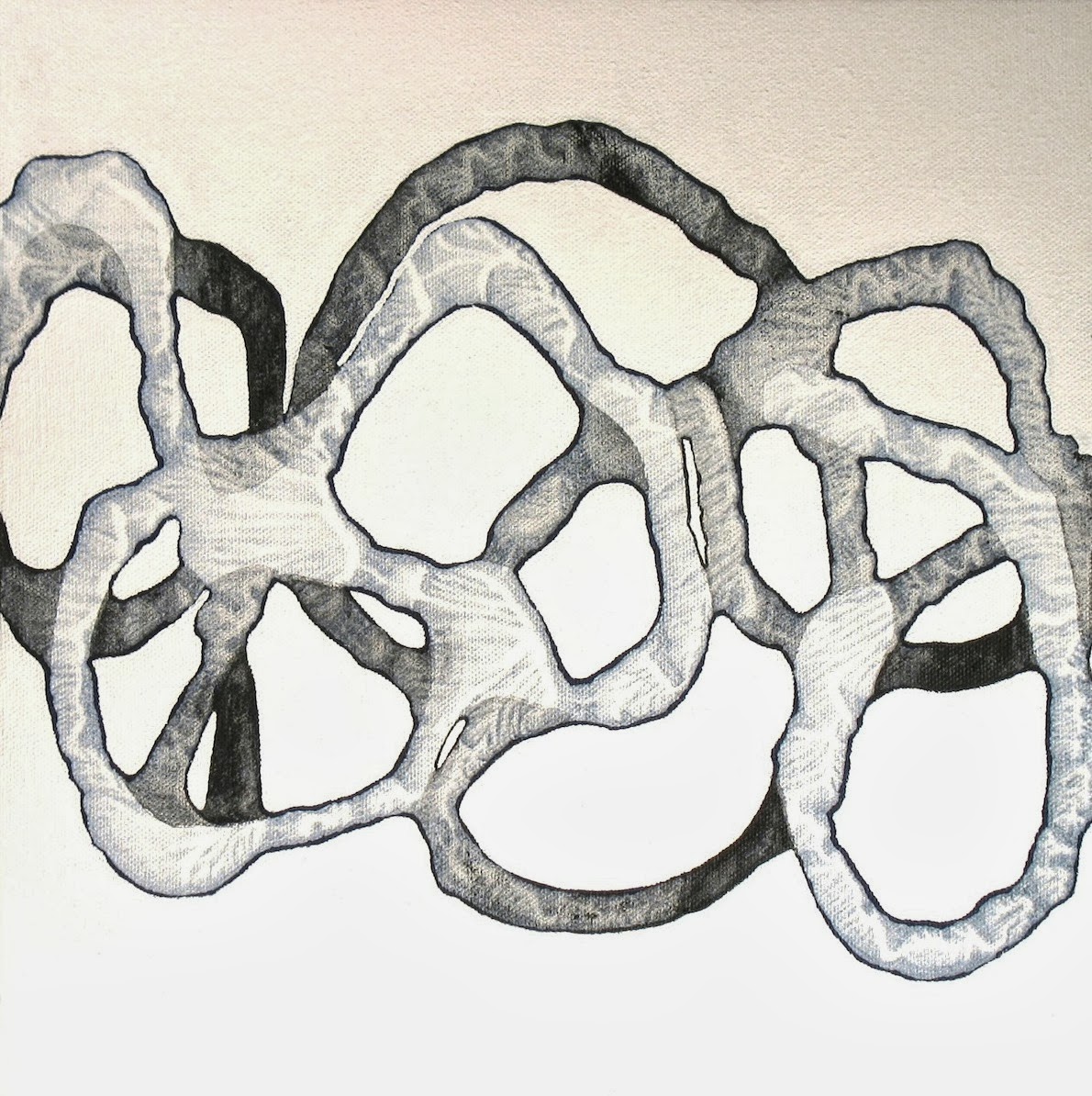
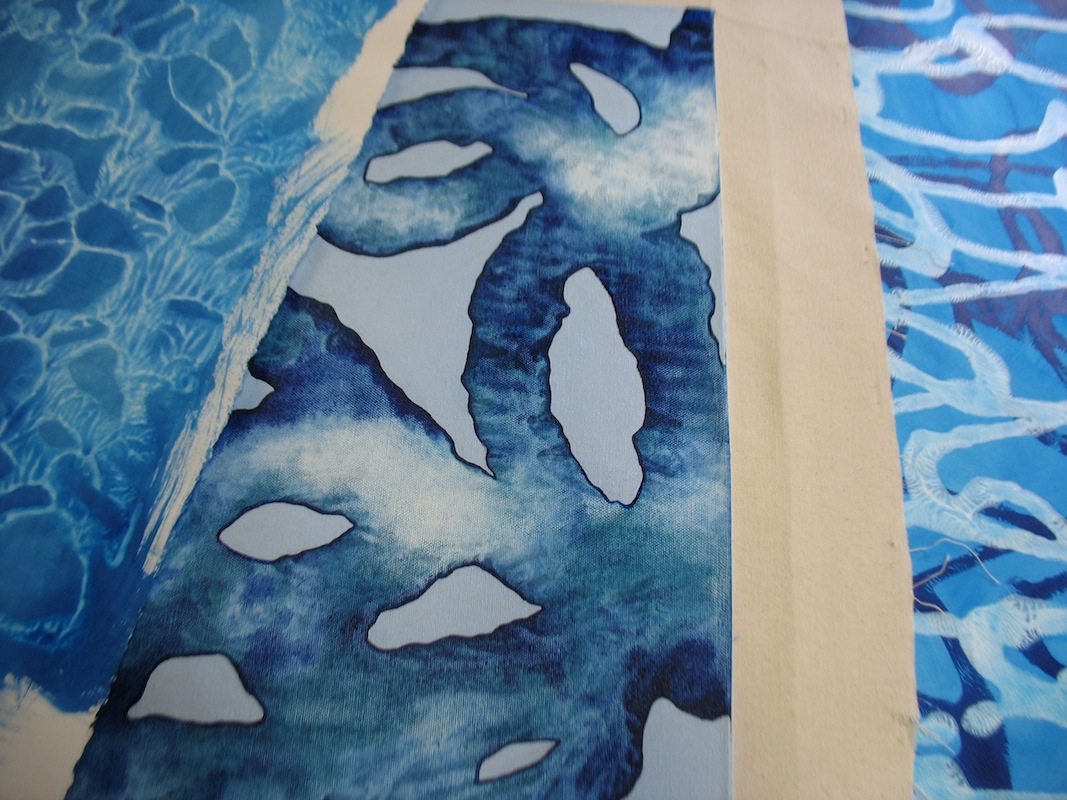
Showing posts with label Realizations on process. Show all posts

Saturday, October 24, 2015

Wrapping up

I am beginning the task of closing up my current studio in anticipation of an upcoming move next spring. It is with mixed feelings that I do so; this space has served me well over the past 11 years, as you can read from this earlier post. I will definitely look back on my time here with fond memories.

However, I am also feeling the need to move on to something new. We artists know the direct if sometimes subconscious effect that one's working space has on the artwork that's produced there. It's probably a good time in my career to shake things up. We'll see what the future holds!

In the meantime, I'm sorting through the flotsam and jetsam of more than a decade of a dedicated studio practice, trying to honestly evaluate what needs to be discarded and what needs to move along with me.

My studio in its heyday (shot in 2014)

Saturday, August 8, 2015

Familiar technique, new destination

New and now in the studio: I've had ideas recently about turning my "Spheres" series ...

 
... into a large wall-mounted installation. I was thinking of mounting the fabric I print onto round canvases and then positioning them across a wall, then I got the idea to press the fabric onto clear contact paper trimmed into circles and mount that on a wall. That's enough of a plan to get me going, so here's the first step: creating the fabric in the first place.


We'll see how the next step goes!

Saturday, July 18, 2015

Old meets new

It's interesting when older works intercept with newer ones, in ways that you as the artist didn't plan or anticipate! These two paintings seem to have been made for each other, even though the one with the circles was created in 2010 and the one with the lines was completed last month. I only noticed the connection because both works were selected for presentation by an art consultant.

"Aquamarine Spheres," acrylic on fabric on canvas, 20" square

"Filigree Square 9," acrylic on canvas, 20" square

Saturday, March 28, 2015

Frustration

When I went to bed last night after time spent in my studio, I left two almost-finished, awesome-looking paintings on my work table. As I was kicking off my slippers and climbing between the sheets, I thought, I have just one more layer, and I'm done! Then I can relish my two new creations.

Well, it didn't quite turn out that way. When I added the final layer just now, UGH. Yuck. Too much. No problem, I thought, it's acrylic, so I'll just rinse off the top layer and I'll be back to the wonderful surfaces I created last night.

No, not happening. Because it had only been about 5 hours since the original layers were created, the water began taking off everything. No problem, I thought. I'll just "go with it," and remove some color and have a soft muted surface.

Not in the cards. The sponge I applied smeared everything, leaving a blurred mess that showed no sign of last night's promise. Gone, bye, unsalvageable. And I have no more canvas, so I'd have to drive out to the store to buy more, and I really don't have enough money in my budget right now for new art supplies.

Sigh. Such is the creative process! Sometimes it works, sometimes it doesn't. I should take comfort in the fact that I HAD two cool paintings that, with effort, time and money, I will be able to duplicate to some degree.

As I was cleaning up my studio in frustration after this experience, I remembered other times in the past when I have been frustrated like this. Well, truth to tell, there are too many to possibly remember them all. That's part of being an artist!

But I remembered two paintings in particular that I really like, and that were a direct result of feeling so angry, desperate, and ready to SCREAM because nothing was turning out that I started slapping stuff on the canvas ... and these spontaneous emotional responses turned out to be much more visually rich than any kind of intentional application.

One of them is the painting "Hook," shown below. I had removed and reworked these large fabric pieces countless times, and still I hated the composition. I finally got so mad that I just pulled them all off the canvas and threw them on the studio floor. Then I had one last impulse to act; not an idea for a solution, mind you, but an undirected burst of energy. I grabbed them off the floor and just stuck them onto the canvas, letting them land anywhere they happened to land. And then I stepped back in amazement. Somehow, this worked better than any of the careful arranging I had just spent hours doing! My initial instincts for color and shape had been fine; I had just been "trying too hard." This remains one of my favorite paintings.

"Hook," acrylic and oil stick on fabric on canvas, 64" H x 44" W, 1998
A similar thing happened with another favorite, "Scribble 1." I was trying to create a collage, again arranging carefully, with torn pieces of paper. Nothing was working. After I tried and tried and tried, I felt frustrated that all of this work was amounting to a big zero. I didn't feel like spending all this time in my studio with nothing to show for it. I happened to have a blank stretched canvas nearby, and I grabbed it and started flinging the collage pieces onto it haphazardly, just gluing them down beside one another, wherever they happened to land.

And you know what? This cool painting resulted!

"Scribble 1," acrylic on paper on canvas, 48" H x 28" W, 2009
I guess there's something to be said for simply letting the painting paint itself. (Jackson Pollock's most famous quote deals with just this issue, and who am I to argue with The Big Guy?) But it's hard to do that! We want a good-looking finished piece to show for all this time spent, dammit! We don't want to have to start all over again from scratch.

Sometimes, however, frustration can lead to spontaneity, and that might be just the "breath of fresh air" that the painting needs.

Tuesday, December 16, 2014

Out of left field

I've just completed a pair of new works on canvas that, due to colorations, resemble landscapes. I love the idea of a vertical "slice" through the type of scene that is traditionally horizontal in format.

What prompted this change of pace, you ask? Nothing carefully considered, frankly - just the fact that my art budget for 2014 has run out, but my desire to create has not! So I am using up whatever stretcher bars, canvas lengths, and paint I have left over until the new year kicks in! (Both are acrylic on canvas, 20" high by 12" wide.)


Monday, November 3, 2014

A touch of red

To switch gears a bit from my recent drawings, tonight I'm patterning some lengths of fabric in anticipation of creating a new collage painting. I enjoy switching modes like this. Some times I feel like working in a detailed manner, as in the precise "bubble" drawings I've been making for the past few months; other times my arm just wants to SWOOP!


Sunday, October 26, 2014

Psyching out my new drawings

As I've completed 15 of my "bubble drawings," I am preparing to get them out into the world as a formal series. This includes writing an artist statement. The series came about very spontaneously; I didn't think about it at all, just made it. But since the artist statement is necessarily a verbal exercise, the experience of composing it caused me to realize many things about both the series itself and my state of mind as its creator. It reads:

My father died in April of this year, and I was so devastated by his passing that I thought I'd never make art again. Even though I had been used to an almost-daily practice of painting or drawing for the past 15 years, I found myself stopping completely and sinking into despair.

Then, after months of feeling so sad, I woke up one morning and realized I suddenly felt better. I felt like myself again,as if the pain had eased and I was ready to embrace life again. These images of bubbles floating through apparently limitless space were the first ideas that came to my mind, and I began putting pencil to paper, one drawing after another.

There was something about the buoyancy of the subject matter and its fleeting nature that seemed to reflect the realizations I had after my father's death. The bubbles have an impermanence to them, like life itself, but there is something in their ephemeral beauty that reminds us to appreciate and enjoy what we have, however limited its duration.

The works are made with white drawing pencil on black charcoal paper. They are created spontaneously, in whatever arrangement I am feeling as I created them. I have chosen to place them in a square format, as it seems to imply a lack of definite time, weight or location. There isn't any particular intention to their compositions, although I was aiming for a range of viewpoints, from up close to far away.

"Bubble 1," pencil on paper, 8 inches square, 2014

"Bubble 2," pencil on paper, 8 inches square, 2014

"Bubble 3," pencil on paper, 8 inches square, 2014

Saturday, October 18, 2014

Autumn studio visit

What every artist dreams of: a quiet, secluded studio; a commitment-free day to work; and a series in progress that's going well, ready to jump into. I feel privileged to say, that is the situation I'm looking at today.

I especially enjoy my studio at this time of year, when the weather is temperate enough to open the door to the outside, and the serene back yard takes on the autumn colors of the season's peak. Here are some views out the door, and a look at the "bubble drawings" I'm currently working on.

Time to put on some soothing music and apply pencil to paper!
 
Let the sun shine in!

Look at those colors!

Series in progress

Saturday, March 22, 2014

Studios I Have Known

This week I've been going through old photographs in order to prepare for an artist talk, and in doing so I've come across, among other things, pictures of my various studio spaces over the years. Seeing them revealed a lot to me about my creative process and the ways in which my work has changed over the years. It's striking to realize what a critical impact your studio has on your art! Here are my three favorite spaces.

This was my studio when I was a graduate student at UMass Dartmouth. It was located in a former gymnasium on Purchase Street in New Bedford (before the Star Store was renovated to accommodate UMD's art program). There were large windows and expansive walls, so I was able to spread out and make bigger works than I had before. (You can see my tiny easel abandoned against the wall.) It was also the former space of my friend Domenic who had graduated before me, and whose work I greatly admired, so I think he left me good vibes floating around the space as well!

New Bedford studio, 1995-7
After graduate school, I was told by fellow artists about studios available in the various mill buildings in Fall River, left vacant when the textile industry moved to the southern states and finally overseas. I contacted the realty office at the King Philip Mill on Kilburn Street, who offered me the space pictured below. "One hundred and fifty dollars a month," the office manager said, and I quickly filled out the first month's check before she realized what I was sure had been a mistake.

The space looked out over a calming pond, and sunlight streamed through the north-facing windows. I was able to work on an even larger scale here, as you can tell by the painting leaning against one of the columns, and my imagery quickly expanded in reflection of the change. (This view shows only half of the space!)

Fall River studio, 1997-2002
Five years later, I moved to the Framingham, Massachusetts, area. It took several tries to find the right studio, but once I did, I've stayed for 10 years (and counting). This space is smaller than the behemoths I worked in before, but it is still sizable. Best of all, it's located right in my home, so I can paint any time of day, even 3 AM (more often than not!). I still have the light of bright windows overlooking nature, plus a big sink and many built-in storage racks. It works so well for me!

Holliston studio, 2004 to present

One day, I expect, life events will propel me along to a new studio. But I'll always look back fondly at these three locations where I was so productive and happy!

Saturday, March 8, 2014

Waiting in the wings

Artists (all of us, not just visual, but poets, composers, choreographers, architects, etc.) are always thinking, dreaming, planning, and scheming about our current or upcoming creative projects. Even when we're walking the dog, changing a diaper, working the day job, or whatever we need to do when we're not in the studio, our bodies might be in "functional" mode but our imaginations are wrapped around our creative challenges.

I haven't worked in a grouping of long, thin panels since last June, when I finished my painting titled "Suspense" (see below). I enjoyed the diversion of using that format, but then returned to my familiar squares. However, a few days ago, my husband found an image in an article on fluid dynamics (see below) that reminded me of the possibilities of vertical panels. Since he shared it with me, I've been turning the idea over in my mind for ways to create a new piece that has the same suspended lines running parallel across the wall, only this time in white on black.

I like the concept of telling a horizontal story through vertical means, as the fluid dynamics model does. My directional lines in "Suspense" repeat, whereas the modifying patterns in the fluid dynamics chart direct the eye horizontally across the panels, while the black strips emphasize verticality. It's a more complex direction I'd love to try.

Now that the notion has reached the "conveyor belt" of creativity, it's just a matter of time before I head in that direction in my studio. Having just completed two new series (on squares) last month, I was in the "take a break/get the work out there" mode. But I find it hard to remain there for long. My hands soon itch to get to making again!

"Suspense," acrylic on five separate stretched canvases, each 56" H x 12" W, 2013
 

More on this developing story to come ...

Wednesday, March 5, 2014

Smiling for the camera

"Throwback Thursdays" have become a regular feature on Facebook, so I thought I'd enter a post on my blog in the same spirit. Below is a portrait of me at age 5, approximately, enacting a scene that has repeated itself many many times over the years: posing against a wall displaying my latest artworks!  These are crayon portraits of my mother, who was (and still is) the most beautiful subject in the world to me. This shot was taken by my grandfather after my grandmother, who was always a great supporter of my artistic aspirations (her father was an artist), had hung my drawings on the wall.

An aspiring artist in 1967
Fast forward 45 years! A few things have changed in that time; I've switched from crayons to acrylic paints, for one. But I'm still making art, and posing alongside it in order to preserve the moment. Here I am in 2012, with several of my artworks on display at a show I curated/participated in at Fountain Street Fine Art.

A professional artist 45 years later
So that's my entry for Throwback Thursday!

Saturday, January 25, 2014

Looking good on paper

I decided to return to working on paper again for a change, after having painted exclusively on stretched canvas for a while. So I purchased a new pack of 30" x 22" paper, loaded up my squeeze bottles with fluid acrylics, and I was ready to go!

In this process, I draw lines with the squeeze bottle onto the paper, lay another piece of paper on top, and roll over it with a brayer, essentially making a monotype. The beauty of this process is that I am left with two replica images; one can be left as is, and the other can be reworked for as long as desired. This eliminates the disheartening "oh no, why did I paint over that - now I've wrecked it!" experience. (We painters are always lamenting that we don't have a "Control-Z" feature when we work ... )

I'm having such FUN!


Thursday, September 26, 2013

Emulating Ernst: An Art History Lesson

Ernst's decalomania
Not only is it an honor to have your work analyzed by an art historian, the experience can be an education in itself.

One of my colleagues, an art history professor, kindly attended the closing reception last night of the three-person show I've just participated in at Framingham State University, titled "Actions \ Reactions." During her visit, she noted the textured surface of the script-like lines in my paintings and told me they reminded her of a process utilized by the Surrealists, Max Ernst in particular, titled "Decalomania."

I'm so grateful to her for this observation because, while I was generally familiar with the series in which Ernst used this technique, I didn't know much about it and certainly had never made the connection between that method of working and what I do in the studio.

Decalomania basically means making a print from a coating of still-wet paint. When the two surfaces are pulled apart, their squishy separation causes a series of intricate ripples that look as though they are the result of painstakingly applied brushwork. And of course they are anything but painstaking! Those little rivulets aren't controlled by the artist at all; like so many interesting surfaces in art, they "just happen."

When I make my line paintings, I "draw" the lines by extruding diluted acrylic paint through ketchup bottles. The lines that flow out of the squeeze bottles are rounded and precise, and often I want them to look flat and wavery. So I lay a sheet of paper on the wet surface, flatten it with a brayer, and peel it off, leaving tiny facets inside each line. That's my personalized version of decalomania!
 
Detail of "Shorthand" by Catherine Carter, acrylic on canvas, 2013, approximately 40" square

I found THIS extensive blog post about the process, and its use by Ernst. This writer suggests that decalomania might have saved Ernst's life! Apparently when he was fleeing Vichy France in 1940, he was stopped just as he was about to board a train bound for Spain. A suspicious official rifled through the belongings he was carrying, which included rolled canvases that happened to include the decalomania technique. The man saw the elaborate "ribbed" sections of Ernst's works and thought he must have painted those areas with a tiny brush. He pronounced, "You, sir, have great talent" and escorted Ernst to the train. (If he hadn't been so transfixed by the technique, he might have been more aware of the works' "untraditional" content and taken the artist into custody!)

HERE is another interesting link about Ernst's masterpiece, "Europe After the Rain II," an oil painting chock full of decalomania.

"Europe After the Rain II" by Max Ernst, oil on canvas, 1940-42, approximately 2 feet high by 5 feet wide.
I feel as if I am in the highest company in using this technique!

Friday, August 30, 2013

Refashioning in the studio

Inspired by the book "Overdressed: The Shockingly High Cost of Cheap Fashion" by Elizabeth Cline (2012), I've done a lot of refashioning lately. You know the scenario: you decide you hate a garment (or ... everything in your closet!) and you just want to get the thing out of your sight. Maybe you've gained (or lost!) weight, or styles have changed, or you just can't figure out what you were thinking when you bought it in the first place. A thriftier and more eco-friendly solution than throwing the item in the trash, or even donating it to charity, is to whip out a pair of scissors and a needle and thread and change up the style. Instant and free "new" garment.

This technique of refashioning has worked well in my closet, so I figured, "Why not in my studio too?"

As with clothing dissatisfaction, I've always liked but not loved the following two diptychs. The squares were made in 2010 and the rectangles in 2012. They've all just sat in my studio because I didn't have enough faith in them to promote them. However, they're not so bad that I'd want to get rid of them. Enter the refashioning method.

Not bad, but ...
OK, but ...

Pretty good, but ...

Lukewarm ...

To make the change, I simply grabbed a pair of scissors and a gallon of gel medium, and voila, two canvas collages on canvas:

Flowing and energetic!

Elaborate and full of depth!

Here's how they look together as a diptych, which is how I would ideally display them:


I've very pleased with the results! It turns out that, just as with clothing, old paintings can be made new again with a little imagination.

Tuesday, August 27, 2013

Visions of shoes dancing in my head


Yesterday I helped my mother do some sorting in her house, which included the discovery of a pile of books I had as a child. In poking through images I hadn't seen in 40 years, I realized how long and hard I had stared at so many of the pictures in these books! It was like I was intent on memorizing the colors, shapes and designs I saw there.

Case in point: here's an old fairy tale book of mine. My favorite story was "The Twelve Dancing Princesses," not so much because I liked that story but because I LOVED looking at the illustrations of the shoes that accompanied it. I even colored in the black and white drawings with crayon! I knew I wasn't supposed to write in my books, never mind color them in, but I couldn't help myself.

Page from "The Red Fairy Book"

Coming across this page is striking, because it reminds me of the shoe drawings I've made in recent years:


And the black ribbon on the shoe drawing on the page in the fairy tale book ...


... reminds me of the black line paintings I've done this year.

"Scrawl 2," acrylic on canvas, 30 inches square, 2013

 So it seems the visual inspirations experienced during childhood settle in our unconscious minds, and remain with us throughout our lives!

Wednesday, May 22, 2013

Old materials, new results


As I wrote in an earlier blog post, "Painting within my means," 2013 is my year to pay off a lingering charge-card debt forever, which means I've been adhering to a strict policy of austerity. And for a former art-store shopaholic like me, that means no new art supplies until the bill is paid off (and from then on, careful consideration before a single penny is spent). I had planned on dealing with this year's restriction by working only in black and white, and re-using old stretcher bars and pieced-together canvas scraps.

That plan has worked fine for the first six months of the year, but I'm finding I'm almost finished with my latest black and white series. Being a person who only feels alive when I'm creating something new and, on top of that, a Gemini, I was beginning to wonder how to deal with the eventual day when I put the last stroke on my black and whites and then start to get antsy for the next project (not to mention a return to color).

An idea came to me this morning, when I thought of a collage I made in 2010 for the Icons + Altars show, which used to be an annual exhibit at the New Art Center in Newton, MA. That year, the deadline for creating a piece for the show was looming and I didn't have time to whip up anything new, so I recombined strips of several old paintings into this collage (below). I liked the result and the piece sold at the event, so I pocketed the proceeds and mentally filed away the technique for future reference.
"Wine Lines," acrylic on paper and fabric on board, 16" square, 2010

When I remembered that experience this morning, I thought of the piles of old paintings and drawings currently languishing in my studio, artworks which weren't bad enough to paint over or throw out, but weren't good enough to exist as finished works on their own. "Hey," I thought, "how about if I recombine them into entirely new pieces?"

So, working intuitively, I put together this collage on a 12" square cradled board I had lying around.

Not yet titled, acrylic on paper on board, 12" square, 2013


The interesting thing about this process is that these various paintings and drawings were made at completely different times (from approximately 2005 to 2012), and created without the idea of their ever coming together. So to combine them together now joins the various techniques and thought processes I've been working on over the years in new and interesting ways. Below are some possible combinations of old works I might try in upcoming collages. We'll see how this new direction unfolds!